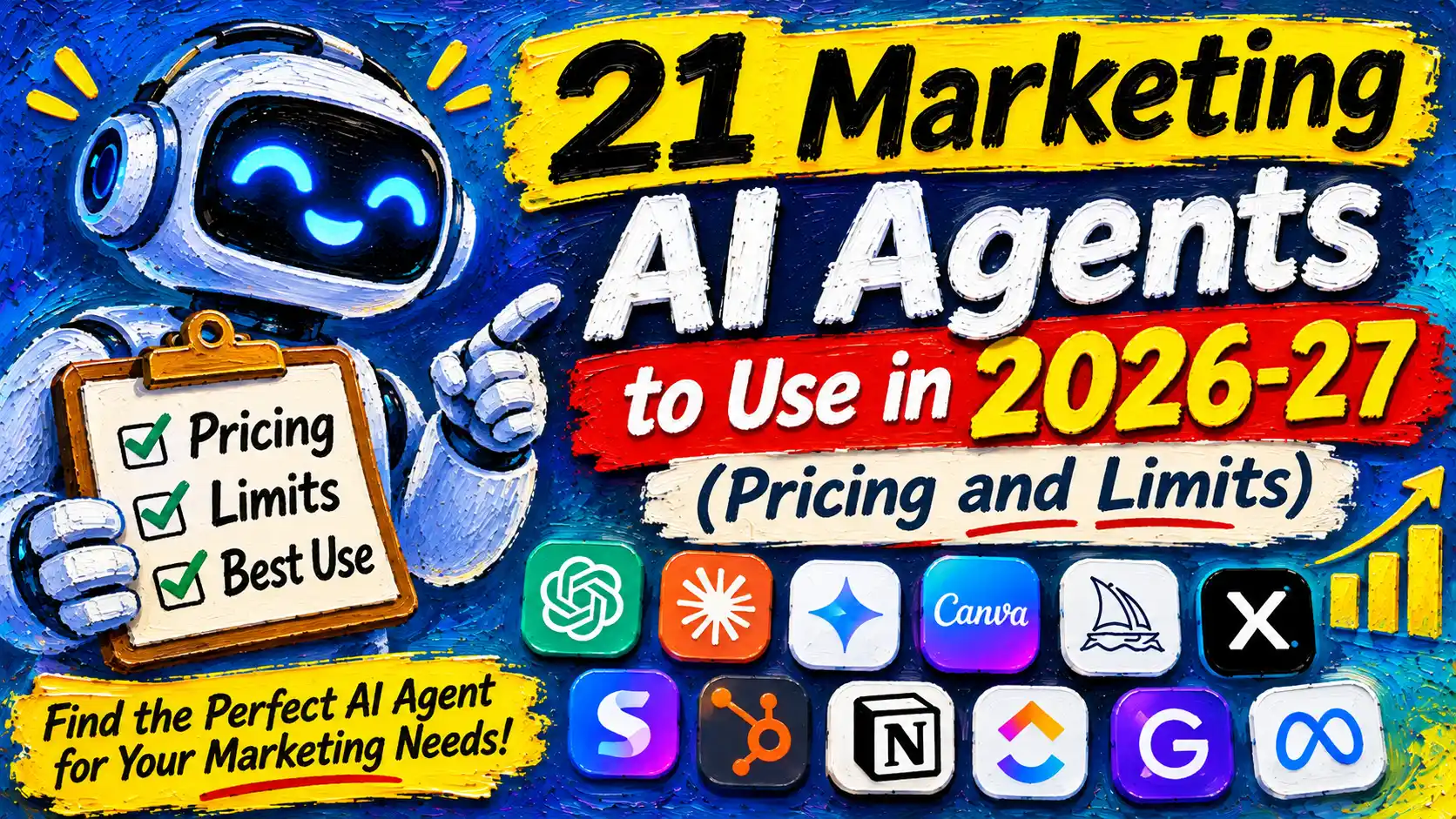
Of the 21 marketing AI agents below, the safest bets in 2026 are the ones inside the platform that already holds your customer data: HubSpot Breeze, Klaviyo, Braze and Salesforce Agentforce. For standalone jobs, pick by task. Jasper suits governed content, Search Atlas OTTO suits SEO fixes, Zapier Agents suits glue work, and Mentionova suits AI-search tracking.
A few numbers explain why the market looks the way it does. HubSpot moved its Customer Agent to $0.50 per resolved conversation on 14 April 2026. Salesforce charges $0.10 per Agentforce action. Zapier gives you 400 free agent activities a month. Klaviyo’s Composer agent went from public beta on 30 June 2026 to general availability by 29 September. Vendors now bill for work done, not seats, and that should change how you shop.
Everything here comes from vendor announcements, documentation and pricing pages read in November 2026. Nobody ran hands-on tests of all 21, so treat vendor results as claims until you test them on your own data.
What a marketing AI agent is in 2026
An assistant suggests. A workflow runs the same fixed steps every time. An agent takes a goal, picks its own next step, uses the tools you connected, and acts.
Say your cost per lead jumped on Tuesday. An assistant explains what a CPL spike usually means. A workflow sends you an alert when CPL crosses a threshold. An agent pulls the campaign data, checks what changed, and tells you the new ad set is the cause. Given permission, it pauses that ad set.
That last clause matters most. Almost every real risk with AI marketing automation sits in the gap between “recommends” and “acts”. The better products let you choose which side of that line each task falls on. If you want a wider catalogue after this list, the marketing category in the FutureToolAI directory has several hundred more tools.
How marketing AI agents are billed in 2026
Check the billing unit before you check the feature list. Three models dominate.
Outcome pricing charges when a job finishes. HubSpot’s April 2026 change put the Customer Agent at $0.50 per resolution and the Prospecting Agent at $1 per recommended lead, with extra credits costing about a cent each. Action pricing charges per step. Salesforce sells Flex Credits at $500 per 100,000, and one Agentforce action uses 20 of them, so $0.10. Activity pricing, which Zapier uses, counts every time an agent calls a tool, searches the web or queries a knowledge source.
Here is why that matters. Salesforce’s own example puts a simple customer exchange at 3 to 6 actions, or $0.30 to $0.60. Suppose your agent averages 5 actions per run and handles 3,000 runs a month. That is $1,500 a month, and the number moves with every extra step you add to the instructions. Research-heavy tasks burn units fastest.
Ask each vendor what exactly counts as one billable unit, whether failed runs count, and whether you can set a hard cap. HubSpot’s credits page and Salesforce’s Flex Credits announcement are the two clearest examples of how to explain this. Not every vendor is that plain.
Marketing AI agents built into your CRM or email platform
These six run inside the system that owns your contacts, which is their biggest advantage. They already have the data, so there is no connector project. The cost is lock-in. If you ever leave the platform, the agent stays behind. For more tools in this area, see the email marketing category.
1. HubSpot Breeze
Breeze is HubSpot’s agent layer. Plans include a monthly credit allowance, and agents spend credits per task. For marketers, the useful pieces are the Content Agent and the custom agent builder, which work off the CRM records you already maintain. HubSpot also lets you cap credit spend, with a default cap reported at up to 50% above the monthly allowance. Partner guides point out that all AI features draw from one shared pool, so a heavy support workload can starve the marketing team. Set per-team budgets early.
2. Salesforce Agentforce
Agentforce runs across Salesforce clouds, marketing included, and is priced by action as described above. Salesforce still offers the older $2-per-conversation model, which can be cheaper for single, long conversations and worse for anything action-heavy. If your campaigns, leads and service history already sit in Salesforce, this is the shortest path to an agent that knows your customers. If they don’t, the data-cleanup bill will arrive before the first useful run.
3. Klaviyo K:AI Marketing Agent and Composer
Klaviyo’s Marketing Agent, announced on 25 September 2025, plans, builds and launches campaigns, flows and signup forms inside Klaviyo under brand guardrails, with a marketer reviewing. Composer is the newer piece. It lets you ask questions about your data, schedule recurring analysis and save a process as a reusable skill. Klaviyo’s Customer Agent handles service and sales chats in the same platform, and its launch post explains how chat data feeds back into segments. This is built for B2C and ecommerce. A B2B team with long sales cycles will find less here.
4. BrazeAI
Braze splits its AI into three parts. Decisioning Studio uses reinforcement learning to pick the channel, message, offer and timing for each customer, and it grew out of Braze’s acquisition of OfferFit. Agent Console builds and manages campaign agents. Operator is an assistant inside the dashboard that writes Liquid and HTML and helps debug. A self-serve version, Decisioning Studio Go, was announced at Braze’s September 2026 Forge event with general availability scheduled for 14 October 2026, so confirm its current status before you plan around it. Braze publishes a guide to its AI tools, and it also added EU hosting for Decisioning Studio in April 2026, which matters for data-residency rules. Customer case numbers on Braze’s site are the company’s own.
5. Iterable Nova Agent
Iterable launched Nova Agent in April 2026. It acts on live customer behavior to adjust campaigns in real time, alongside new tools for audience activation, ad syncing and governance. Real-time decisioning cuts both ways. It can respond faster than any human, and it can also make a bad call faster than anyone can catch it. If you pilot it, start with one low-stakes journey and review what it changed each week. Demand Gen Report’s coverage has the launch details.
6. ActiveCampaign Active Intelligence
ActiveCampaign’s AI layer builds automations from a plain-language prompt, drafts content and predicts which contacts are likely to convert. It is aimed at small businesses and solo marketers, which makes it the friendliest entry point on this list. It is less of a fully autonomous agent than Klaviyo or Braze. Think of it as a fast builder with predictions, and judge it on that.
AI content marketing tools and SEO agents
Content is where bad agent output is easiest to publish and hardest to undo. Google’s spam policies target scaled, low-value content, so the useful agents here add governance, research or measurement, not just volume. The SEO generator category and the copywriting category list more options.
7. Jasper
Jasper now describes itself as AI infrastructure for marketing teams, not a writing assistant. It has 100+ specialized agents, content pipelines, a Canvas workspace and Jasper IQ, a layer that stores brand voice, style guides, audience profiles and product knowledge and applies them to every output. Teams can build custom agents in AI Studio. It fits larger teams that need consistent voice across many writers and markets. Solo marketers will pay for governance they don’t need, and higher tiers are priced by quote.
8. Copy.ai
Copy.ai began as a copy generator and moved toward go-to-market workflows, where research, outreach drafts and content are chained into automated steps. That suits teams that want repeatable sequences, such as researching a prospect and drafting the first email, without writing code. Check its current plans before committing, because positioning in this category shifts quickly.
9. Writer
Writer targets large and regulated companies. It runs its own Palmyra models, includes an agent builder, and applies style and compliance rules to what comes out. If legal review is the real bottleneck in your content process, that rules layer is the reason to look at it. For a five-person startup it is more machinery than the job needs.
10. AirOps
AirOps builds content workflows for SEO and AI search. The pitch is research, writing and refreshing pages in a repeatable pipeline, plus tracking how your content appears in AI answers. Refreshing old pages is usually a better use of an agent than writing new ones, because the page already has rankings and links to protect. Review every refresh before it goes live.
11. Search Atlas OTTO
OTTO is the most autonomous SEO tool here. You install the OTTO Pixel, and it scans the site, then deploys fixes such as meta tags, schema and content changes without a developer ticket. It connects to Google Analytics, Search Console and Google Business Profile, and an OTTO Agent chat lets you ask for audits and reports. Search Atlas says you can turn on approval mode so nothing goes live until you review it. Turn it on. Autonomous deployment to a production site is the exact situation where a human check pays off. Details are on the OTTO SEO page.
12. Mentionova
Mentionova tracks how brands appear in ChatGPT, Perplexity, Claude, Gemini, Google AI Overviews and Reddit, per its own materials, and produces daily briefs with ranked actions. Visibility in AI answers is becoming its own measurement problem, and rank trackers don’t cover it. Be careful with the many “best AI visibility tools” roundups that put it first, since several read like vendor content. Test it and alternatives such as Ahrefs Brand Radar or Otterly on the same set of 20 prompts and compare. The vendor describes the product on its AI visibility tracking page.
Agents for paid media, outreach and conversion
Money leaves your account while these run, so permissions matter more than features. Start every one of them with a spend cap and read-only access.
13. Albert.ai
Albert is built for autonomous paid media across search, social and programmatic. You set goals and budget limits, and it adjusts bids, audiences and creative placement. It suits teams with enough monthly ad spend to give the system data to learn from. Small budgets rarely produce the volume an autonomous optimizer needs.
14. Smartly.io
Smartly focuses on social advertising at scale, with creative automation and rule-based budget management across the major social platforms. Ask the vendor which parts of your plan are agentic and which are plain automation rules. Both are useful, but they are priced and governed differently. Its social media category neighbors include lighter options.
15. Mutiny
Mutiny personalizes website content for target accounts and uses AI to produce and test page variants, which makes it a B2B tool. It makes sense when you run account-based campaigns and your landing pages are the weak link. If your traffic is mostly anonymous and low volume, there is too little data for personalization to learn from.
16. Instantly.ai
Instantly handles cold email outreach, with inbox warmup, a lead database and AI-assisted replies. It is popular because it is cheap to scale, and that is also its risk. Cold email falls under CAN-SPAM in the US and GDPR and similar rules elsewhere, and mailbox providers punish high complaint rates. An agent that sends faster just gets you blocked faster. Pair it with tight targeting and a clear unsubscribe path. More tools like it sit in the lead generation category.
Agent builders for custom marketing automation AI tools
Pre-built agents cover common jobs. When your workflow is odd, such as a weekly report assembled from five tools, you build it. These five let you do that without engineering help, to varying degrees. The automation and agents category lists 400+ more.
17. Zapier Agents
Zapier Agents lets you describe a task and connect it to Zapier’s app library. Billing is in activities, separate from regular task counts. The free tier includes 400 activities per month, and pricing guides list roughly 1,500 on the first paid tier, with a cap on activities per run (10 on free, 40 on paid, according to a pricing tracker). Quote the live pricing page, because Zapier restructured its pricing in 2026 and third-party numbers disagree. Free is enough to test one agent, not to run a team on.
18. Relevance AI
Relevance AI is a no-code platform for building agents and teams of agents. It is the choice when you want several agents handing work to each other, such as a researcher that feeds a writer that feeds a reviewer. Multi-agent setups multiply both capability and cost, so run one agent well first.
19. Lindy
Lindy builds agents for email triage, scheduling, lead routing and similar operational chores. It is a good fit for the unglamorous work around marketing, like routing inbound leads or drafting follow-ups. Its template approach gets you started quickly, but templates still need your rules about tone and escalation.
20. Gumloop
Gumloop is an LLM-agnostic builder, so you pick which model powers each agent, and it connects to Slack so people can talk to agents where they already work. It publishes a template library covering competitor SEO analysis, blog audits, Google Ads analysis, UTM building and TikTok creator vetting, among others. Those templates are a good starting point, but they are also the vendor’s own demonstrations. Treat them as drafts to adapt.
21. Bardeen
Bardeen works in the browser, scraping pages, copying data and pushing it into tools like Sheets and CRMs. It fills a gap the API-based tools leave, which is sites with no API. The trade-off is fragility, since a page redesign can break a flow. Keep a human in the loop for anything feeding a customer-facing system.
How to pick marketing AI agents without wasting a quarter
Most failed agent projects fail the same way. Someone buys four tools, connects none of them properly, and nobody owns the results.
Start from the data, not the feature list. If your customers and campaigns live in HubSpot, test Breeze before any standalone agent. An agent without clean data is a confident guesser.
Pick one job with a number attached. “Cut weekly reporting from four hours to one” is testable. “Be more productive” is not. Write the baseline down before the agent runs, then compare after a month.
Set the autonomy level per task. Reading data and drafting can be automatic. Publishing, spending money and emailing customers should need approval until the agent has a track record. Search Atlas’s approval mode and HubSpot’s credit caps exist for exactly this.
Treat vendor case studies as marketing. A 14% subscription lift at one streaming brand, or a Fortune 500 logo wall, tells you the product can work somewhere. It does not tell you it will work with your list size and offer. Run your own 30-day pilot with a control group.
Budget for review time. An agent that writes 50 drafts a week creates 50 things to read. Count that labor honestly. You can compare feature sets side by side in the FutureToolAI comparison tool, and the analytics category covers measurement tools for the pilot.
Questions marketers ask about AI agents
Will AI agents replace marketers?
They replace tasks. Pulling a report, resizing a creative, drafting a first email and tagging UTMs are tasks. Deciding positioning, picking what to test and judging whether an output is good enough still need a person who understands the customer. The teams getting results use agents to cut admin and spend the saved time on strategy.
Is it safe to give an agent access to customer data?
It depends on the vendor and your setup. Check where data is stored, whether it trains vendor models, and what certifications exist. Gumloop, for example, says it is SOC 2 and GDPR compliant, and Braze offers EU hosting for Decisioning Studio. Give agents the narrowest access that works, preferably read-only first, and keep personal data out of prompts unless the contract allows it.
Do I need to know how to code?
No for most of this list. HubSpot, Klaviyo, ActiveCampaign, Zapier, Lindy and Gumloop are built for non-developers. Knowing how your own process works matters more than syntax, because the agent’s instructions are essentially a written procedure.
Which agent should a small team start with?
Start with whatever is already in your email or CRM tool, since that costs nothing in integration work. Without one, Zapier Agents’ free tier or a Gumloop template is a low-risk way to test a single task. Hold off on enterprise platforms like Jasper, Writer or Salesforce until you have a repeatable job worth scaling.
How long before an agent pays for itself?
There is no reliable industry benchmark, and anyone quoting one is guessing. Your own baseline is the only honest answer. Measure hours saved or cost per result for 30 days, then subtract subscription fees, usage charges and the time spent reviewing output.
Do AI marketing agents hurt SEO?
Unreviewed bulk content can, because Google’s spam policies cover scaled, low-value pages. Agents that audit, refresh or interlink existing pages carry less risk than ones that publish new articles on their own. Edit anything that carries your name.
Can one agent handle every channel?
Not well. Channel-specific agents with their own context, such as one for SEO and another for ads, tend to give better results than a single generalist, and they are easier to audit. A small set of focused agents with clear owners beats one broad system that nobody understands.
How do I check whether AI assistants mention my brand?
Start by hand. Write 20 to 30 prompts your buyers would plausibly ask, run them in ChatGPT, Gemini and Perplexity, and log which brands appear and which sources get cited. Repeat monthly. Tools like Mentionova automate that loop, but the manual version tells you whether the problem is worth paying to track.